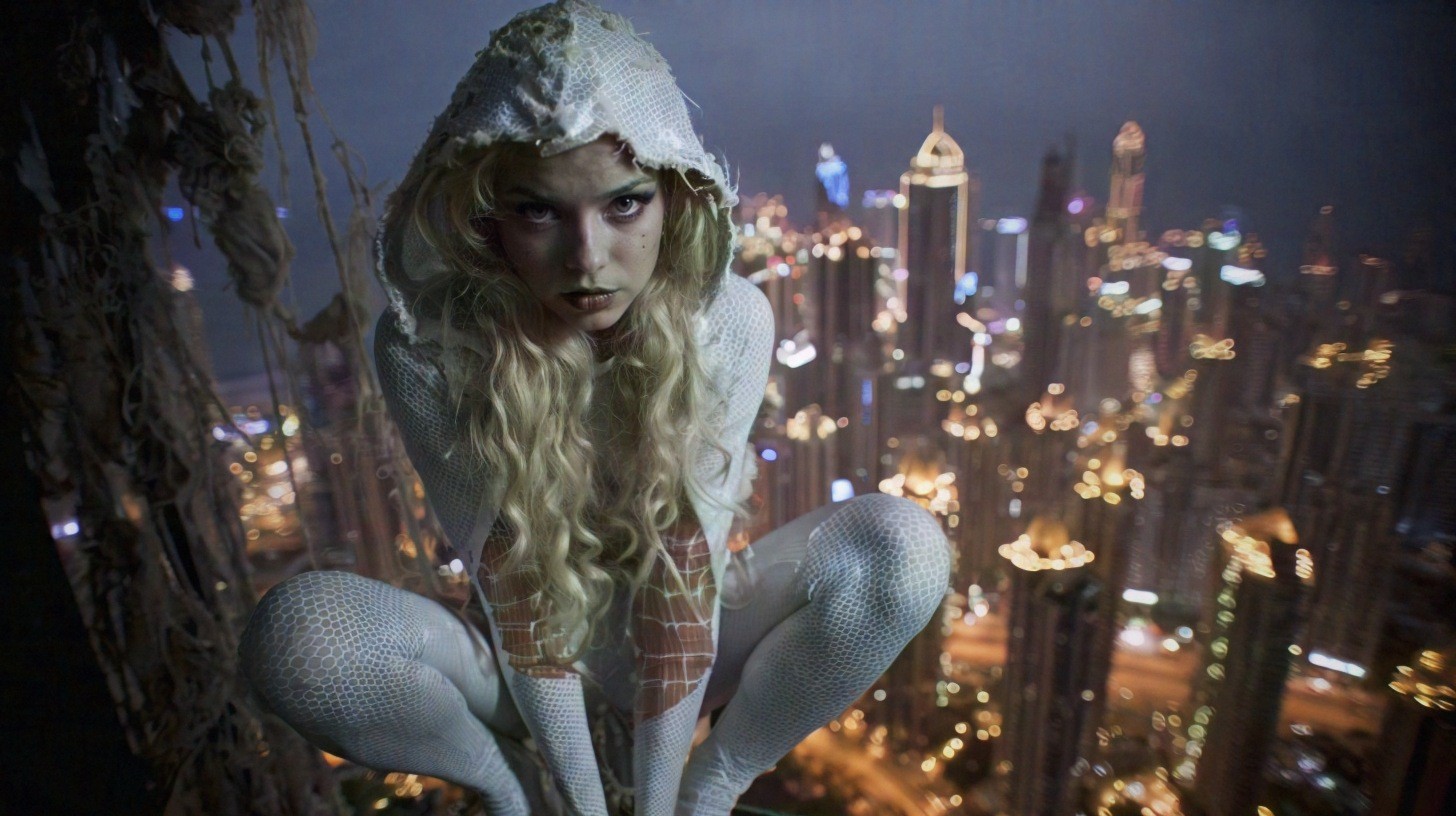
Spider-Gwen - officially Ghost-Spider in current Marvel Comics continuity - is a character I always enjoy photographing because she feels built for motion, rhythm, and immediacy. Created by Jason Latour and Robbi Rodriguez and first appearing in Edge of Spider-Verse #2 in 2014, she became a mainstream icon through her central roles in Spider-Man: Into the Spider-Verse (2018) and Spider-Man: Across the Spider-Verse (2023). There's a youthful confidence to her presence, but also a kind of emotional tension beneath it - someone balancing responsibility, identity, and momentum all at once. Visually, with her white, black, and pink suit and distinctive hood, she is one of those rare characters where color, silhouette, and attitude all do equal storytelling work, which makes her incredibly rewarding to translate into photography.
For this shoot, I wanted to move away from clean, static hero imagery and instead build something that felt like it was captured mid-chase. The concept centered around Gwen existing in a fragmented urban environment - somewhere between rooftops, alleyways, and unfinished architectural spaces. We chose a location with layered vertical structure and strong negative space, allowing her to feel like she could move through the frame rather than simply exist inside it.
A key element of the shoot came from an unexpected environmental detail. During the session, intermittent construction machinery in a nearby area created irregular vibrations through metal scaffolding we were shooting against. Instead of fighting it, we timed exposures to those subtle tremors, which introduced a slight, almost imperceptible shake to certain frames. The effect wasn't blur in the traditional sense - it created a feeling of unstable footing, as if the environment itself was reacting to her movement.
Lighting was approached as if it were part of the city's nervous system. We used hard, directional light sources mixed with pockets of cooler ambient spill to mimic the feeling of streetlights, signage, and hidden architectural illumination. In a few shots, reflections from nearby glass surfaces bounced unexpected pink and blue tones back into the frame, unintentionally reinforcing her signature color palette in a way that felt organic rather than designed.
One of the most compelling aspects of the shoot came from working with real-world elevation changes. Rather than simulating movement in post, we used stairwells, ledges, and partial drops in terrain to physically shift her position between frames. That allowed each image to feel like a true moment in a larger sequence rather than a composed still.
What I find most compelling about photographing Spider-Gwen is that she never feels stationary, even when she is completely still. There is always a sense that something has just happened - or is about to. For me, this shoot was about capturing that in-between energy: a world in motion, a character in transition, and a frame that feels like it was briefly caught in passing rather than carefully staged.