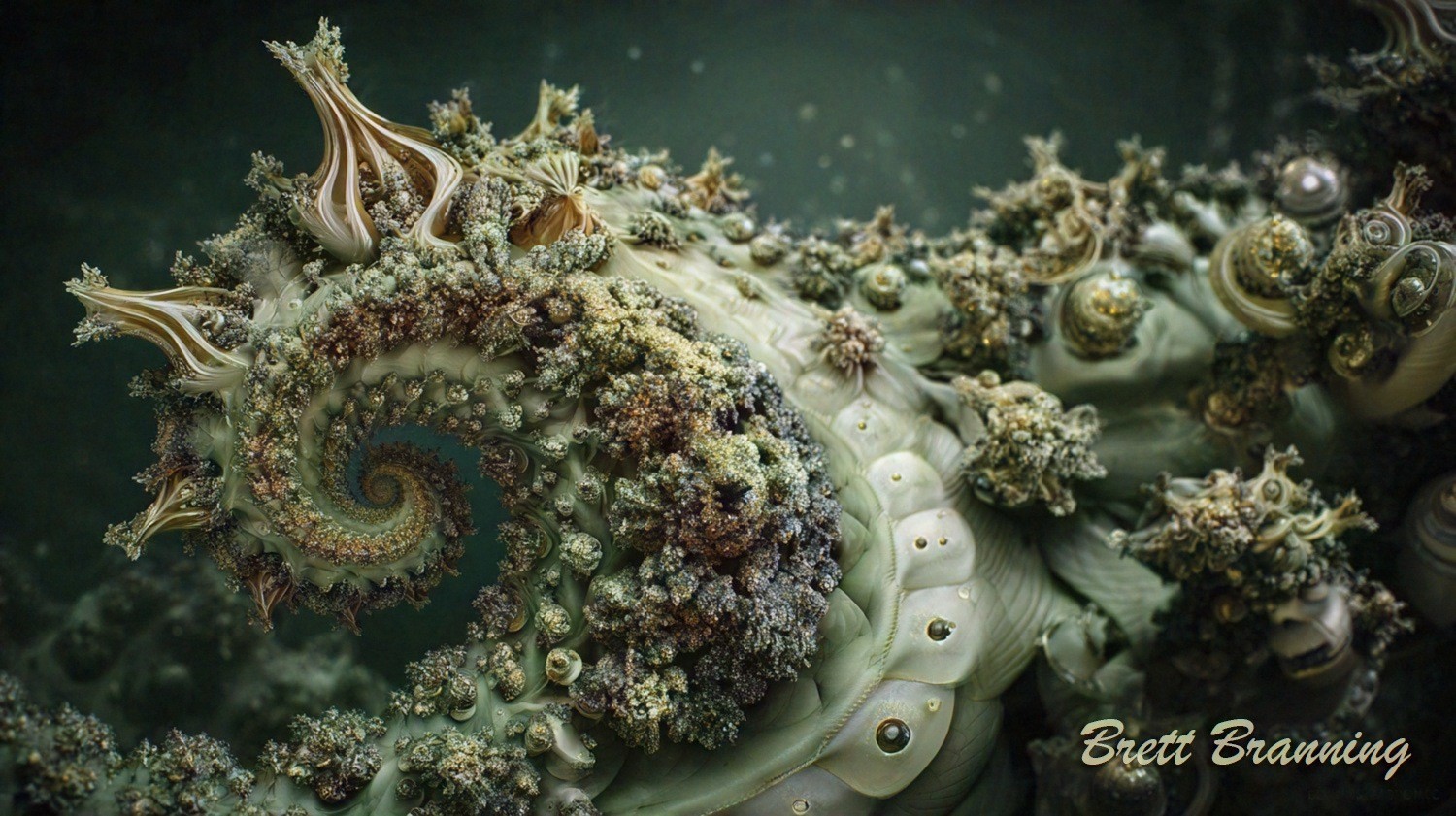
Crown of the First Queen is a piece that reminds me that complexity in fractal art does not always come from increasingly elaborate mathematics. In fact, one of the most interesting aspects of this work is that it was created using some of the simplest equations of any fractal artwork in my portfolio. While many of my projects involve highly layered formulas, numerous transformations, and extensive experimentation with obscure parameters, this image emerged from a surprisingly straightforward mathematical foundation. It serves as a personal reminder that beauty often arises not from complexity alone, but from how simple ideas interact and evolve.
The inspiration for the piece came during a period when I was spending many evenings listening to the symphonic metal band Nightwish while exploring new fractal forms. Their music has always been particularly effective at triggering visual ideas for me. The combination of orchestral grandeur, fantasy themes, and cinematic atmosphere naturally encourages my imagination to wander into fictional worlds populated by ancient kingdoms, forgotten myths, and legendary figures. As I worked on this piece, I found myself envisioning the ceremonial regalia of a ruler whose story had long since faded into legend.
The title Crown of the First Queen emerged from that imagery. Rather than depicting a literal crown, I imagined an artifact so revered that it had become the foundation of an entire mythology. The structure began to feel less like jewelry and more like a monument-an object imbued with generations of history, symbolism, and collective memory. In my mind, the First Queen was not simply a ruler but a semi-mythical figure whose legacy shaped an entire civilization. The crown became a symbol of origin, authority, and continuity, passed down through countless ages until its true story was nearly forgotten.
What fascinated me most during the creation process was how much visual richness emerged from such modest mathematical beginnings. Working within Mandelbulb3D, I discovered what I find most compelling about generative fractal art-that even simple equations can produce extraordinary forms when viewed from the right perspective and refined through careful parameter adjustments. Intricate filigree-like structures, layered arches, and jewel-like formations gradually revealed themselves within the geometry, creating the impression of elaborate craftsmanship despite their mathematical origins.
As the piece developed, I focused heavily on composition and atmosphere rather than pursuing additional complexity. The goal was to create an image that felt regal and timeless, allowing the structure itself to carry the narrative. Subtle lighting, carefully balanced colors, and an emphasis on elegant silhouette all helped reinforce the feeling that the viewer was encountering an artifact of immense cultural significance.
Looking back, Crown of the First Queen remains one of my favorite examples of how fractal art can surprise its creator. It demonstrates that a powerful image does not necessarily require the most complicated formula or the most technically demanding setup. Sometimes a simple mathematical foundation, combined with imagination and careful artistic direction, can give rise to an entire world of stories waiting to be discovered.