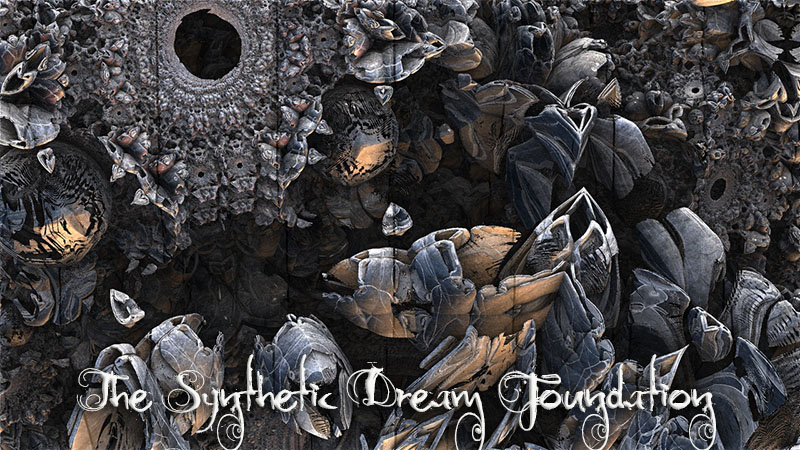
Ring of Elland occupies a particularly important place in my fractal art journey because it represents a turning point not only in the visual direction of my work, but also in the techniques I used to create it. While many of my earlier pieces existed entirely within the rendering environment of Mandelbulb3D, this was the first artwork where I began exporting fractal meshes into dedicated 3D modeling software, opening entirely new possibilities for materials, lighting, color control, and surface detail. Looking back, this piece marks the moment when my fractal work began evolving from pure mathematical exploration into something that felt increasingly cinematic and sculptural.
The inspiration behind Ring of Elland can actually be traced back many years to my very first encounter with fractal art. I still remember sitting in front of a computer late one evening, watching someone zoom endlessly into a Mandelbrot set. At first, I assumed the image would eventually dissolve into noise or repetition. Instead, every level revealed new worlds hidden within the previous one. The experience genuinely altered the way I thought about mathematics. Until that moment, I had largely viewed mathematics as a practical tool, but suddenly it appeared capable of generating beauty, mystery, and complexity on a scale that rivaled anything found in nature. That first encounter left a lasting impression on me and ultimately became one of the reasons I began creating fractal art myself.
The title Ring of Elland emerged from an imaginary mythology that developed while I was building the piece. In that mythology, Elland is an ancient civilization that sought to understand the hidden architecture underlying reality itself. The Ring serves as both a gateway and a symbol-a monument built not by hands, but by the mathematical forces that govern the universe. I imagined it as an artifact discovered drifting between dimensions, endlessly generating new structures as it slowly rotates through space.
From a technical standpoint, this piece became an important milestone. After generating the primary fractal structure within Mandelbulb3D, I exported the geometry into a 3D modeling environment where I could refine materials, introduce more sophisticated lighting setups, and create a level of surface richness that was difficult to achieve using fractal rendering alone. Metallic textures, subtle weathering, layered reflections, and atmospheric depth all contributed to a final image that felt less like a render and more like a photograph of an impossible object.
What continues to resonate with me about Ring of Elland is that it captures both a beginning and an evolution. It reflects the sense of wonder I felt when first discovering fractals while simultaneously representing a leap forward in my artistic process. In many ways, the piece serves as a bridge between mathematical exploration and visual storytelling-a reminder that behind every equation lies the potential for entire worlds waiting to be uncovered.